

Transportation of Natural Gas
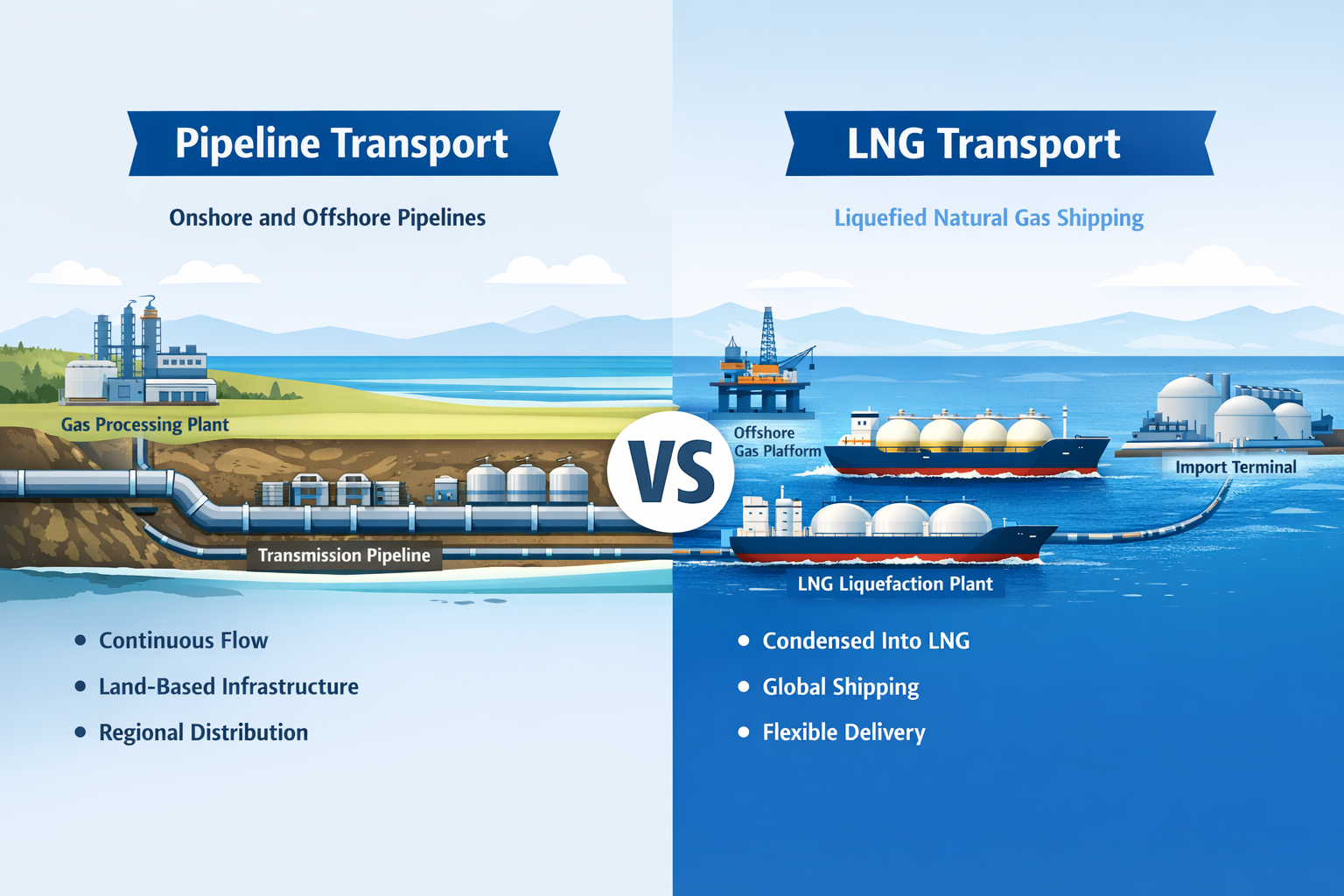 Natural gas is transported from production sites to consumers through a combination of pipelines, storage systems, and liquefied natural gas (LNG) shipping. Because supply and demand vary seasonally—typically higher in winter—efficient transport and storage systems are essential.
Pipeline Transport
Pipelines are the most common method for transporting natural gas over land. They form extensive networks that connect production sites, processing facilities, storage locations, and end users.
There are three main types of pipelines:
- Gathering pipelines transport raw natural gas from wells to processing plants
- Transmission (interstate) pipelines carry processed gas over long distances to storage and distribution systems
- Distribution pipelines deliver gas directly to consumers
These systems operate under high pressure and require careful monitoring to ensure safety and efficiency.
Storage of Natural Gas
Natural gas can be stored for extended periods in underground storage facilities, such as depleted oil and gas fields, aquifers, or salt caverns.
Storage plays a key role in balancing supply and demand, allowing gas to be stored during periods of low consumption and used during peak demand—particularly in colder months.
LNG: Transporting Gas Over Long Distances
In regions where pipelines are not feasible—such as offshore fields or remote Arctic areas—natural gas is transported as liquefied natural gas (LNG).
To create LNG, natural gas is cooled to approximately −162°C, at which point it becomes a liquid. This process reduces its volume by about 600 times, making it much more efficient to transport.
Before liquefaction, impurities such as water, carbon dioxide, and sulfur compounds are removed to ensure safe processing and transport.
LNG Shipping and Regasification
LNG is transported in specially designed cryogenic tankers, equipped to keep the gas at extremely low temperatures.
Once the LNG reaches its destination, it is regasified—warmed back into a gaseous state—and then either:
- fed into pipeline systems
- stored for later use
This flexibility makes LNG a critical component of global gas supply, particularly for remote or offshore regions like the Arctic.
Gas Transport in the Arctic
In the Arctic, vast distances, offshore resources, and limited infrastructure make LNG increasingly important. While pipelines are used in some regions, LNG transport enables access to global markets where pipeline connections are not practical.
However, Arctic transport systems face additional challenges, including:
- extreme weather and ice conditions
- high infrastructure and operating costs
- environmental and safety considerations
Sources: NaturalGas, U.S. Energy Information Administration (EIA)