
Natural Gas in the Arctic
 Resource Potential
The Arctic holds substantial reserves of natural gas, both discovered and yet to be developed. The largest known reserves are located in northern Russia, particularly in Siberia and offshore regions such as the Barents Sea. Significant gas resources are also found in Norway, Canada, and Alaska.
Today, natural gas is considered one of the most important energy resources in the Arctic, with ongoing development in several regions, especially in Russian and Norwegian waters.
Formation and Composition
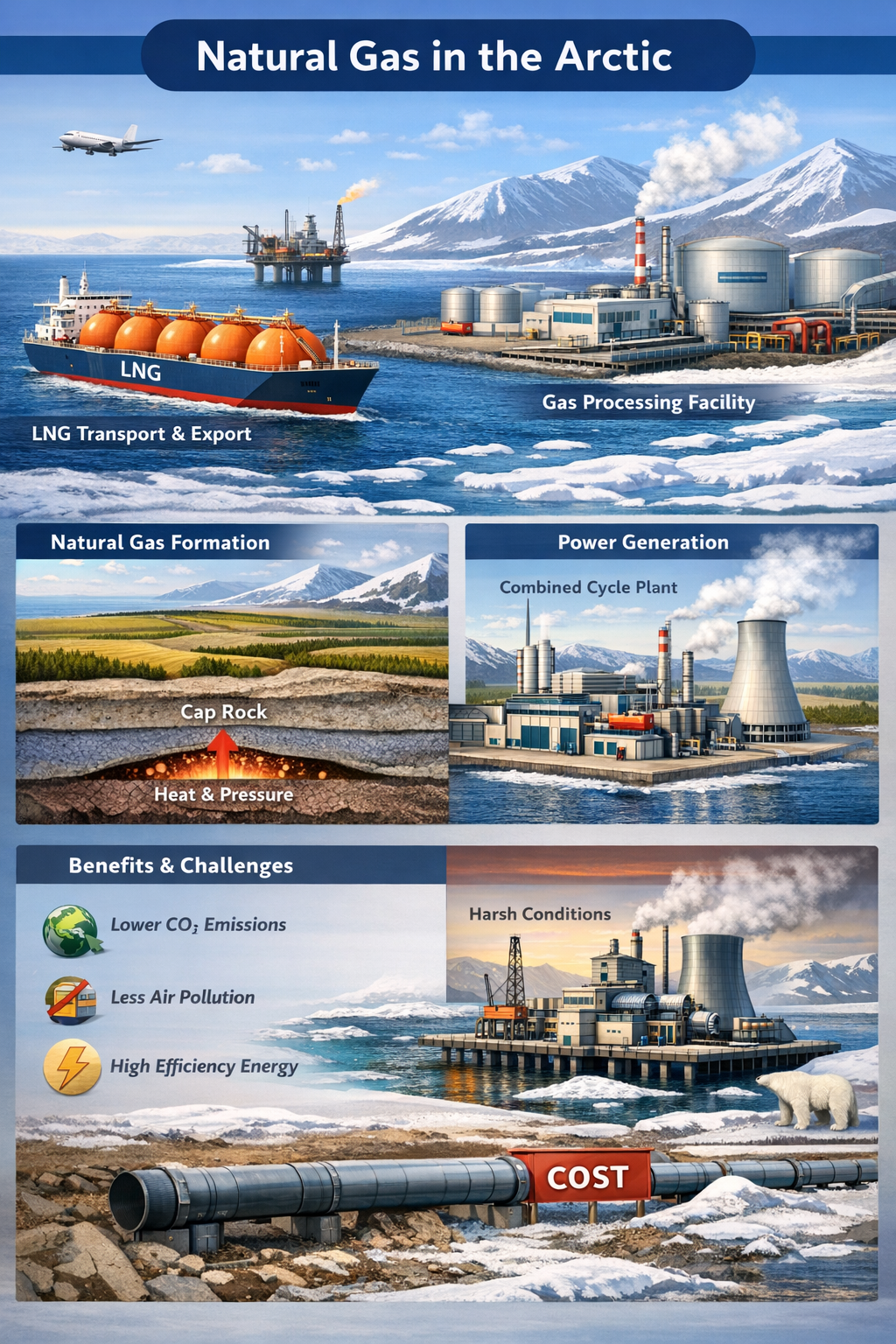
Natural gas forms through geological processes similar to those that create oil, originating from buried organic material subjected to heat and pressure over millions of years.
It is composed primarily of methane, typically making up 60–90% of the gas, with smaller amounts of ethane, propane, and butane. The exact composition varies depending on the reservoir.
Before natural gas can be used commercially, it must be processed to remove impurities such as carbon dioxide, sulfur compounds, water, and other trace elements.
Advantages of Natural Gas
Compared to other fossil fuels, natural gas is often considered a lower-emission energy source. It offers several advantages:
- Lower carbon dioxide emissions per unit of energy than coal and oil
- Minimal sulfur emissions, reducing air pollution
- High energy efficiency when used in modern power systems
Because of these properties, natural gas has played a key role as a transition fuel in global energy systems.
Use in Power Generation
Natural gas is widely used in electricity generation, particularly in combined cycle power plants, where gas turbines are paired with steam turbines to maximise efficiency.
This method is one of the most efficient ways to generate electricity from fossil fuels and is widely used in regions where natural gas is available at competitive cost.
Natural gas is also used in remote and off-grid energy systems, which are common in Arctic regions.
Arctic Gas Development Today
In recent years, Arctic gas development has expanded, particularly through large-scale projects such as liquefied natural gas (LNG) production and export facilities. These allow gas to be transported from remote Arctic regions to global markets.
At the same time, Arctic gas projects face challenges similar to oil development, including:
- harsh environmental conditions
- high infrastructure costs
- environmental and climate concerns
Looking Ahead
While natural gas remains a major resource in the Arctic, its future role is increasingly influenced by the global shift toward low-carbon energy systems. Although it emits fewer greenhouse gases than other fossil fuels, it is still a source of carbon emissions.
As a result, Arctic gas development is likely to continue, but within a changing energy landscape shaped by climate policy, technological innovation, and evolving energy demand.
of generating power using hydrocarbon fuels, and this technology is accordingly widely used wherever gas can be obtained at a reasonable cost.
Sources: International Energy Agency (IEA), Global Greenhouse Warming