
Future Development of Nuclear Energy
 Uncertain but Evolving Future
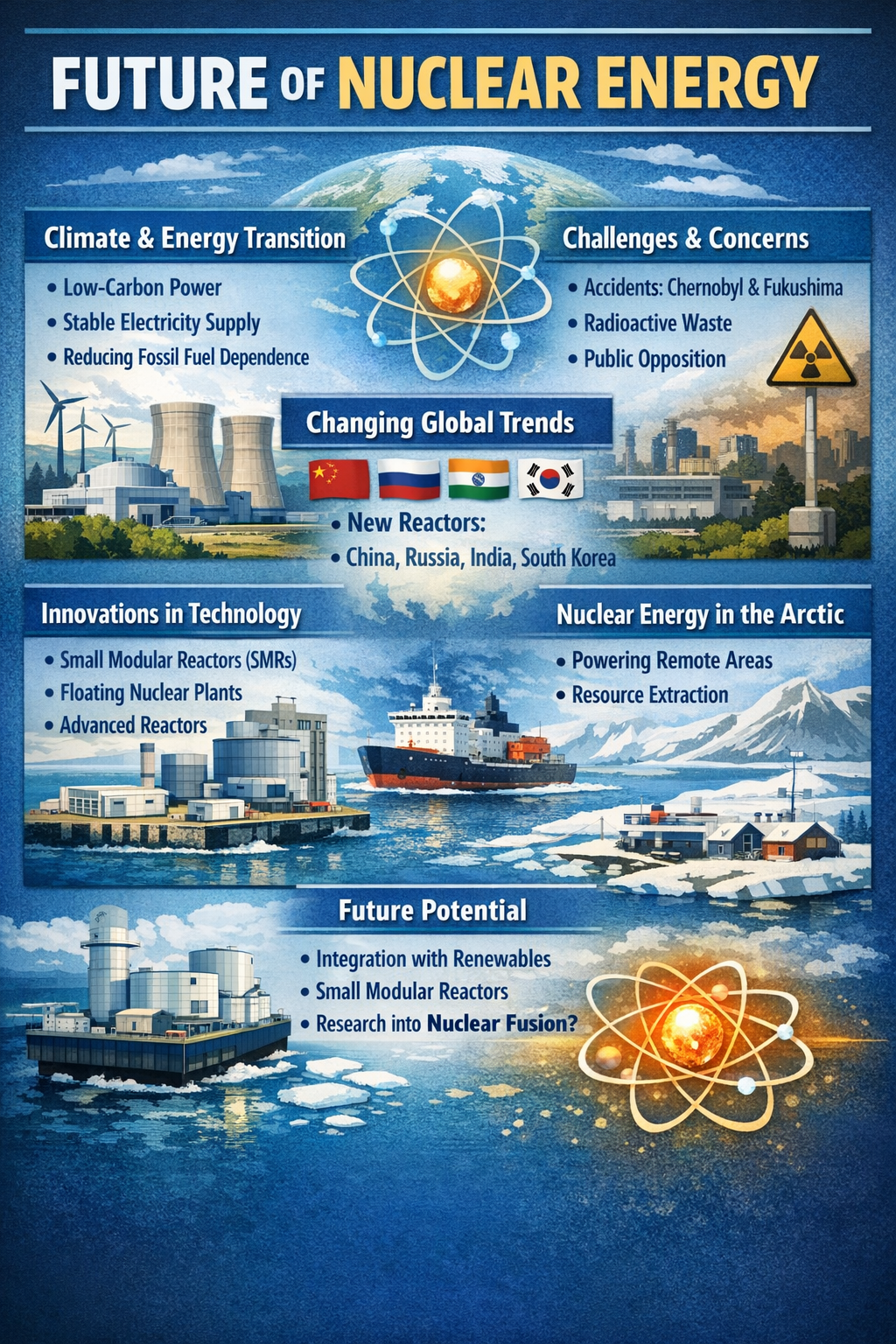
Predicting the future of nuclear energy remains complex. It is shaped by competing global priorities, including the need for reliable low-carbon energy and concerns about safety, cost, and waste management.
Role in Climate and Energy Transition
Nuclear energy is increasingly discussed as part of the solution to climate change:
- Provides low-carbon, stable electricity
- Supports energy systems when renewable sources are intermittent
- Helps reduce dependence on fossil fuels
As global energy demand continues to grow, nuclear power is being reconsidered in many countries as part of a balanced energy mix.
Challenges and Public Concerns
Despite its advantages, nuclear energy faces ongoing challenges:
- Risk of accidents, highlighted by Chernobyl (1986) and Fukushima (2011)
- Long-term storage and disposal of radioactive waste
- High construction and maintenance costs
- Public opposition in some countries
These concerns continue to influence national energy policies.
Changing Global Trends
The nuclear industry has changed significantly in recent years:
- Some countries, such as Germany, have phased out nuclear power
- Others are expanding or maintaining nuclear energy as part of their energy strategy
- The global fleet of reactors is aging, but many are being upgraded or extended
Construction of new reactors continues, particularly in:
- China and India
- Russia
- South Korea
In Europe, Finland has recently completed a new reactor (Olkiluoto 3), one of the most advanced in the world.
Innovation and New Technologies
Recent technological developments are shaping the future of nuclear energy:
- Small Modular Reactors (SMRs): smaller, more flexible, and potentially safer reactors suitable for remote regions, including the Arctic
- Floating nuclear power plants: already in use in Russia to supply energy to remote Arctic areas
- Advanced reactor designs: improved safety systems and efficiency
These innovations aim to reduce costs, improve safety, and expand the use of nuclear energy.
Nuclear Energy in the Arctic Context
In the Arctic, nuclear energy may play a specific role:
- Providing energy to remote settlements and industrial sites
- Supporting resource extraction activities
- Complementing renewable energy systems in isolated regions
However, environmental sensitivity and safety concerns remain particularly important in these regions.
Future Potential
Looking ahead, nuclear energy may develop in several directions:
- Greater integration with renewable energy systems
- Expansion of SMRs for decentralized energy supply
- Continued research into nuclear fusion, which could provide nearly limitless energy with minimal waste
While fusion is not yet commercially viable, it represents a long-term possibility for global energy systems.
Sources: World Nuclear Association, OECD Nuclear Energy Agency (NEA), International Atomic Energy Agency (IAEA)