
Sir John Franklin (1786-1847) - The Erebus
 Sir John Franklin (16 April 1786 – 11 June 1847) was a British naval officer and Arctic explorer best known for leading the ill-fated 1845 expedition to chart and navigate the Northwest Passage. His final voyage aboard HMS Erebus and HMS Terror became one of the most enduring mysteries in the history of polar exploration.
Early Naval Career
Franklin joined the Royal Navy at the age of 14 and served in several major naval campaigns during the Napoleonic Wars and the War of 1812. He also participated in early British Arctic expeditions, gaining experience in polar navigation and survival.
Between 1819 and 1822, Franklin led an overland expedition to explore parts of northern Canada. The journey was marked by extreme hardship, starvation, and loss of life. Despite these challenges, Franklin gained a reputation for determination and endurance.
The Search for the Northwest Passage
By the mid-19th century, European powers were determined to complete the mapping of the Northwest Passage — a sea route linking the Atlantic and Pacific Oceans through the Canadian Arctic Archipelago.
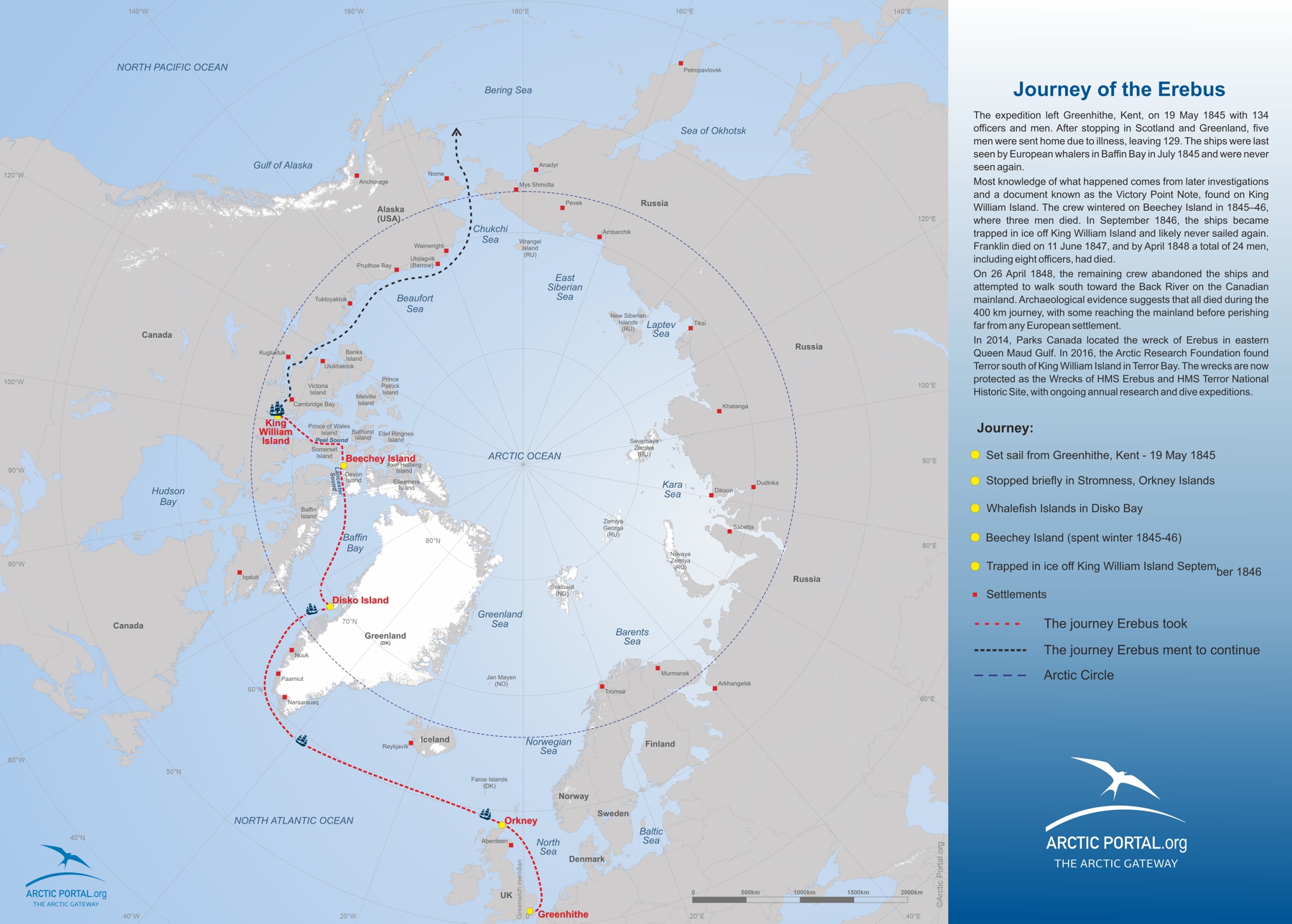
In 1845, Franklin was appointed commander of a new expedition to attempt the final, unmapped section of the passage. The expedition departed from Greenhithe, Kent, on 19 May 1845 with two reinforced ships, HMS Erebus and HMS Terror, and a crew of 129 officers and men.
The ships were considered technologically advanced for their time, equipped with strengthened hulls, auxiliary steam engines, and provisions intended to last several years.
The Route North
After leaving England, the expedition first stopped at Stromness in the Orkney Islands, where they took on fresh supplies before continuing westward across the Atlantic.
From there, the ships sailed to Greenland. They anchored at the Whalefish Islands in Disko Bay, on Greenland’s west coast, where final preparations were made before entering the Canadian Arctic. After departing Greenland, Erebus and Terror sailed into Baffin Bay, waiting for favorable ice conditions to cross into Lancaster Sound, the eastern gateway to the Northwest Passage.
The ships were last seen by European whalers in July 1845 in Baffin Bay.
The Final Voyage
Franklin and his crew spent the winter of 1845–1846 at Beechey Island, where three crew members died and were buried.
In September 1846, Erebus and Terror became trapped in sea ice off King William Island. The ships are believed never to have sailed again.
According to a note later discovered at Victory Point on King William Island, Franklin died on 11 June 1847. By April 1848, a total of 24 men had died. The remaining crew abandoned the ships and attempted to walk south toward the Canadian mainland in a desperate effort to reach the Back River.
None survived.
Discovery and Investigation
For decades, the fate of the Franklin expedition remained uncertain. Numerous search missions were launched in the following years, contributing significantly to the mapping of the Canadian Arctic.
Information gathered from Inuit oral histories, combined with archaeological discoveries, revealed that the crew suffered from extreme cold, starvation, illness, and possibly lead poisoning. Artifacts and human remains found along their intended route suggest that many perished during a desperate overland march.
In 2014, the wreck of HMS Erebus was discovered in Queen Maud Gulf. In 2016, HMS Terror was located in Terror Bay. These discoveries confirmed many details of the expedition’s final movements and renewed global interest in Franklin’s story.
Legacy
Although Franklin did not survive to complete the Northwest Passage, the many search expeditions that followed greatly expanded European knowledge of the Canadian Arctic. Ironically, the Northwest Passage was successfully navigated decades later by Roald Amundsen between 1903 and 1906.
Today, Franklin’s final voyage remains a powerful symbol of the ambition, risk, and human cost associated with Arctic exploration. The wrecks of Erebus and Terror are now protected as a National Historic Site of Canada.
