
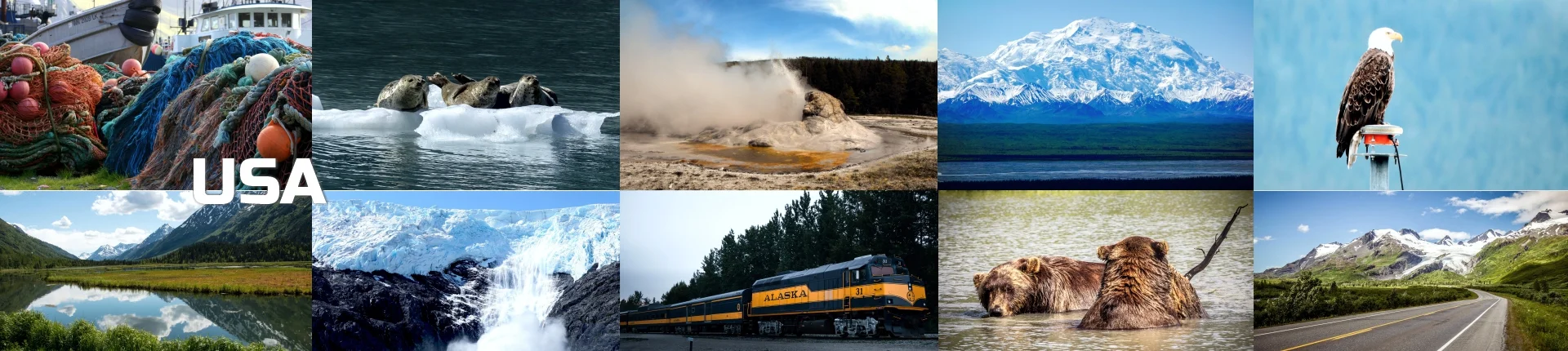
United States


Capital
Washington, D.C.
Alaska: Juneau

Population
349,035,000
Alaska: 783,000 (2026)

Currency
US Dollar (USD)

Government
U.S. State
Federal System

Highest Mountain
Denali (Mount McKinley)
6,190 m

Longest River
Yukon River
3,190 km

Arctic Circle Crosses
Yes
Northern Alaska

Coastline
19,924 km
Including Islands & Territories

Timezone
UTC-10 to UTC-5
UTC-10 to UTC-4 summer
USA is an Arctic nation through Alaska, the northernmost of its 50 states. The US bought Alaska from Russia for 7 million Dollars in 1867; it became the 49th state within the US in 1959. USA is a member of NATO, and its priorities in the Arctic include national and homeland security, environmental protection, sustainable development, promoting cooperation and collaboration with the other Arctic nations, involving Indigenous peoples in decisions that affect them, and supporting and promoting scientific research across the region.
Geography and History
Geographically, Alaska is separated from the contiguous United States by Canada. There are very few roads in the Alaskan Arctic, and many rural communities can only be accessed by aircraft or snowmobile in good weather. The capital of Alaska is Juneau, although the city of Anchorage is the most well-known. Alaska has approximately 737,400 inhabitants, over half of whom reside in Anchorage and Fairbanks. About 50 thousand people live in the Arctic part of Alaska, in the North Slope Borough, the Northwest Arctic Borough, and the Nome Census Area.
Alaska’s western maritime boundary, separating the waters of the United States and Russia, was established in the Treaty of Cession of 1867. It runs through the Chukchi Sea and the Bering Strait to a point between Alaska’s St. Lawrence Island and Russia’s Chukotskiy Peninsula and to the southwest, between Attu Island, the westernmost island of the Alaskan Aleutian chain, and the Russian Komandor Islands. The boundary leaves a patch of international waters, known as the “Doughnut Hole,” in the Bering Sea.
The first European settlement was established in 1784 by Russians at Three Saints Bay, near present-day Kodiak. With the arrival of the Russian fur traders, many native Unangan were killed by the newcomers, by diseases, or overworked in the hunting of fur seals. The Russian-American Company brought the first Christian missionaries to Alaska in the late eighteenth century. The Russian Orthodox Church converted many Alaska Natives to Christianity. The Russian-American Company continued to govern Alaska until the region’s purchase by the United States in 1867.
The first major wave of in-migration from the conterminous United States to Alaska occurred in the 1880s when gold was discovered, and fish canneries were developed. The construction of the Alaska Railroad and the development of copper mining at Kennecott attracted more settlers throughout the 1920s and ’30s. Alaska became a significant military outpost during World War II as a base from which to attack the Japanese, who had invaded parts of the Aleutian island chain, and to provide military assistance, primarily combat aircraft, to Russia. During the war, the U.S. Army uprooted most of the native Unangan from the Aleutian Islands and sent them to work in canneries, sawmills, hospitals, and schools or to internment camps in Juneau or on the southeastern islands.
After World War II, population growth was related to the construction of numerous military bases and the development of petroleum and natural gas in the Kenai Peninsula and at Cook Inlet. Alaskans voted in favor of statehood in 1946 and adopted a constitution in 1956. Congressional approval of the Alaska statehood bill in 1958 was followed by formal entry into the union in 1959.
One of the major conflicts over Alaska’s natural resources occurred in the late 1960s and early 1970s between conservationists and petroleum companies over the proposed Trans-Alaska Pipeline, which now runs from the oil-rich North Slope on the Arctic Ocean to Valdez, in the south. The debate intensified following a catastrophic oil spill in 1989, when the tanker Exxon Valdez released more than 250,000 barrels of oil into Prince William Sound.
Indigenous people
Alaska Natives make up 14.3% of the population of the State of Alaska. Tribes are generally divided into six major groupings: Unangan (Aleut), Sugpiaq (Alutiiq), Yupik (Central Yup’ik and Siberian Yupik), Iñupiaq (Northwest Alaskan Inuit), Athabaskans (Interior Indians), and Tlingit and Haida (Southeast Coastal Indians). Of these, the Yup’ik, Athabaskans, and Inupiaq have traditional homelands above the Arctic Circle, with the Yup’ik and Inupiaq spreading across the Russian and Canadian borders, respectively.
The Alaska Native Claims Settlement Act of 1971 (ANCSA) was a new approach by Congress to federal Indian policy. ANCSA extinguished aboriginal land title in Alaska. It divided the state into twelve distinct regions and mandated the creation of twelve private, for-profit Alaska Native regional corporations and over 200 private, for-profit Alaska Native village corporations. ANCSA also mandated that both regional and village corporations be owned by enrolled Alaska Native shareholders. Unlike in the lower-48 states where the reservation system was the norm, ANCSA departed significantly – its foundation was in Alaska Native corporate ownership.
Through ANCSA, the federal government transferred 44 million acres – land to be held in corporate ownership by Alaska Native shareholders – to Alaska Native regional and village corporations. The federal government also compensated the newly formed Alaska Native corporations a total of $962.5 million for land lost in the settlement agreement. ANCSA had expansive effects, reaching far beyond Alaska Native people.
Economy
Alaska is rich in resources, including petroleum and natural gas. Petroleum production and mining have been major industries. Since the discovery of petroleum at Prudhoe Bay on the North Slope in 1968, and long beyond its peak production in 1988, oil has been the backbone of Alaska’s economy. Today, 85% of Alaska’s state budget comes from oil and mineral-related activities. The oil industry accounts for roughly one third of Alaskan jobs and over half of the state’s entire economy. Mining is also a contributing sector to the economy, providing 3,232 full-time-equivalent jobs in 2016 with 2.83 billion in total reported value. Mines in Alaska include gold, silver, coal, copper, lead, and zinc. Other prominent industries include fishing and tourism, which are of rising importance and demand. Nearly two million people travel to Alaska each year to visit its vast glaciers, mountains, and wildlife.
Arctic Governance
The United States held the country’s first Arctic Council chairmanship from 1998-2000, and again from 2015-2017. Throughout its most recent chairmanship, the United States’ priorities included Arctic Ocean safety, addressing the impacts of climate change, and improving economic and living conditions in the Arctic. The US will have its next chairmanship from 2031-2033.
Sources:CIA World Factbook, The Arctic Institute, The Arctic Council, Britannica, The Cambridge History of the Polar regions,