
Iceland
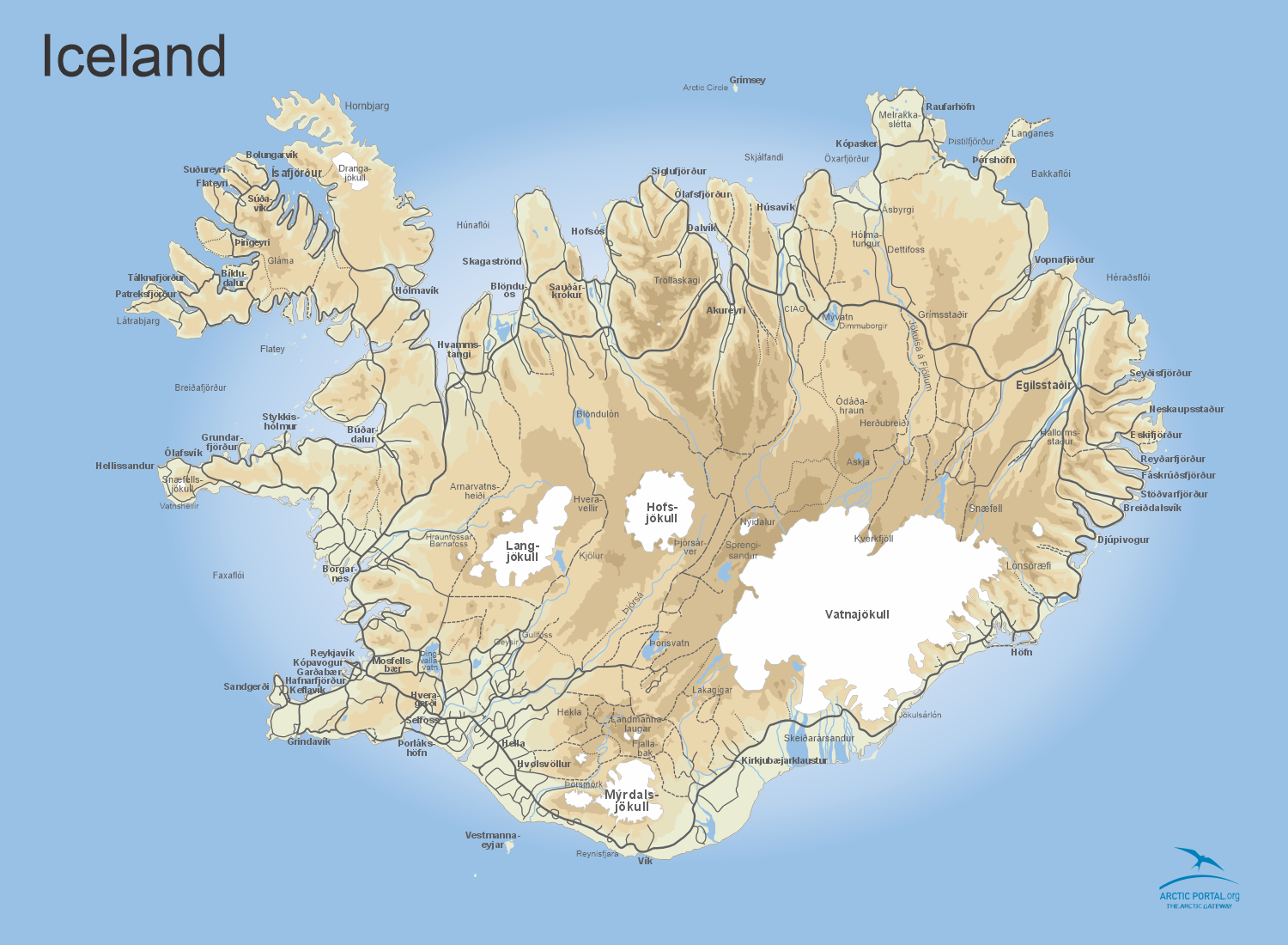 Although only a very small part of Iceland lies within the Arctic Circle, the country is widely regarded as one of the eight Arctic states. The Arctic Circle crosses the island of Grímsey, located off the northern coast of Iceland, making it the northernmost inhabited part of the country.
Unlike the other Arctic states, Iceland is often described as the only state located entirely within the broader political definition of the Arctic region. Its geographic position in the North Atlantic gives the country an important role in Arctic cooperation, shipping, research, and environmental monitoring.
Climate and Geography
Iceland has a sub-Arctic and maritime climate shaped strongly by the North Atlantic Ocean and the Gulf Stream. Winters are generally milder than in many Arctic regions, although cold spells and severe weather can occur. Summers are cool, with average temperatures in July often around 10–12°C.
The country is characterized by volcanic landscapes, glaciers, geothermal areas, lava fields, and rugged coastlines. Iceland is also one of the most geologically active places on Earth, located along the Mid-Atlantic Ridge where the Eurasian and North American tectonic plates meet.
Glaciers cover approximately 10 percent of Iceland’s land area, though many have been retreating rapidly in recent decades due to climate change.
Population and Economy
Iceland has a population of around 400,000 people, with the majority living in and around the capital area of Reykjavík in the southwest.
Historically, the Icelandic economy relied heavily on fisheries, which remain one of the country’s most important industries. In recent decades, tourism, renewable energy production, technology, and international services have become increasingly significant sectors.
Iceland is a global leader in the use of renewable energy, with nearly all electricity generated from hydropower and geothermal energy. The availability of relatively inexpensive renewable power has supported the growth of energy-intensive industries, including aluminum production and data centers.
Iceland’s Role in Arctic Cooperation
Iceland plays an active role in Arctic governance and international cooperation. The country is a founding member of the Arctic Council and has consistently emphasized the importance of sustainable development, marine protection, scientific research, and international dialogue in the Arctic.
Several Arctic Council working groups and institutions have strong links to Iceland. The country hosts the secretariats of:
- Conservation of Arctic Flora and Fauna (CAFF)
- Protection of the Arctic Marine Environment (PAME)
Iceland has also contributed significantly to Arctic research and policy development through institutions such as the University of Akureyri and the Stefansson Arctic Institute.
One notable achievement during Iceland’s Arctic Council chairmanship (2002–2004) was the publication of the first Arctic Human Development Report, which highlighted the social, cultural, and economic realities of Arctic communities.
Shipping and Strategic Location
Iceland’s location between North America and Europe gives it growing strategic importance as Arctic shipping routes receive increased global attention.
As sea ice declines in parts of the Arctic Ocean, discussions have intensified about future trans-Arctic shipping routes connecting the Atlantic and Pacific Oceans. Iceland has explored opportunities to develop itself as a logistics and service hub for Arctic shipping and maritime activity.
Potential development of deep-water ports, especially in northern and eastern Iceland, has periodically been discussed as part of broader Arctic transportation strategies. Iceland’s advanced infrastructure, search and rescue capabilities, renewable energy resources, and proximity to Arctic sea routes strengthen its strategic position in the North Atlantic.
Iceland and Arctic Energy Development
Iceland has also shown interest in Arctic energy and offshore resource development. Earlier discussions focused on potential hydrocarbon resources in the Dreki area northeast of Iceland, although exploration activity has slowed considerably in recent years due to market conditions, environmental concerns, and the global energy transition.
At the same time, Iceland has become increasingly involved in renewable energy innovation, carbon capture research, and sustainable ocean industries, reflecting changing priorities within Arctic economic development.
The country may also continue to play an important supporting role for activities related to Greenland, particularly in transportation, logistics, aviation, tourism, research, and maritime services because of the relatively short distance between Iceland and Greenland.
Iceland in a Changing Arctic
Climate change is having significant impacts on Iceland, especially through glacier retreat, coastal change, shifting marine ecosystems, and increased weather variability. These environmental transformations are closely linked to broader Arctic changes occurring across the circumpolar North.
As interest in the Arctic continues to grow internationally, Iceland remains an important actor in Arctic diplomacy, science, sustainability, and regional cooperation. The country continues to emphasize peaceful cooperation, environmental stewardship, and responsible development as key principles for the future of the Arctic region.
Source:CIA World Factbook