
News
New Global Platform Launches to Improve Access to Polar Observing Information: Registry of Polar Observing Networks (RoPON
A major step forward for the global polar research community has been achieved with the official launch of the Registry of Polar Observing Networks (RoPON), a new online platform designed to make information about high-latitude environmental observing systems significantly more findable, accessible, and interoperable. RoPON serves as a comprehensive catalog of systems and related organizations that coordinate or track observing activities and infrastructure across the Arctic, Antarctic and Southern Ocean regions.
 Developed to address long-standing challenges stemming from fragmented and distributed observing efforts, RoPON provides a unified entry point for researchers, planners, community members, and decision-makers to discover who is monitoring what, where, and why. The platform offers discovery-level details such as network descriptions, observational scope, spatial extent, and links to available data resources.
A Collaborative Effort Driven by the Polar Research Community
RoPON was created through a collaboration between the Sustaining Arctic Observing Networks (SAON) initiative, Arctic Portal, and the University of Colorado Boulder, with financial support from SAON and the NOAA GOMO Arctic Research Program.
The platform also reflects contributions from the SAON Polar Observing Assets Working Group (POAwg), which continues to develop metadata models supporting observingnetwork interoperability and standardization.
Why RoPON Matters
Polar observing efforts have long been distributed across numerous institutions, agencies, and projects, resulting in duplication, inefficiencies, and limited visibility. RoPON addresses these challenges by:
- Helping planners assess status, overlaps, and gaps in observing efforts
- Supporting strategic decisions to colocate and optimize resources
- Improving transparency for communities affected by nearby monitoring activities
- Advancing the FAIR Principles—making observational information Findable, Accessible, Interoperable, and Reusable
Ultimately, RoPON serves as an enabling tool that connects diverse and scattered observing systems —such as monitoring sites, mobile platforms, research projects, stations, field campaigns, and observing programs- enhancing scientific collaboration and informed decision-making.
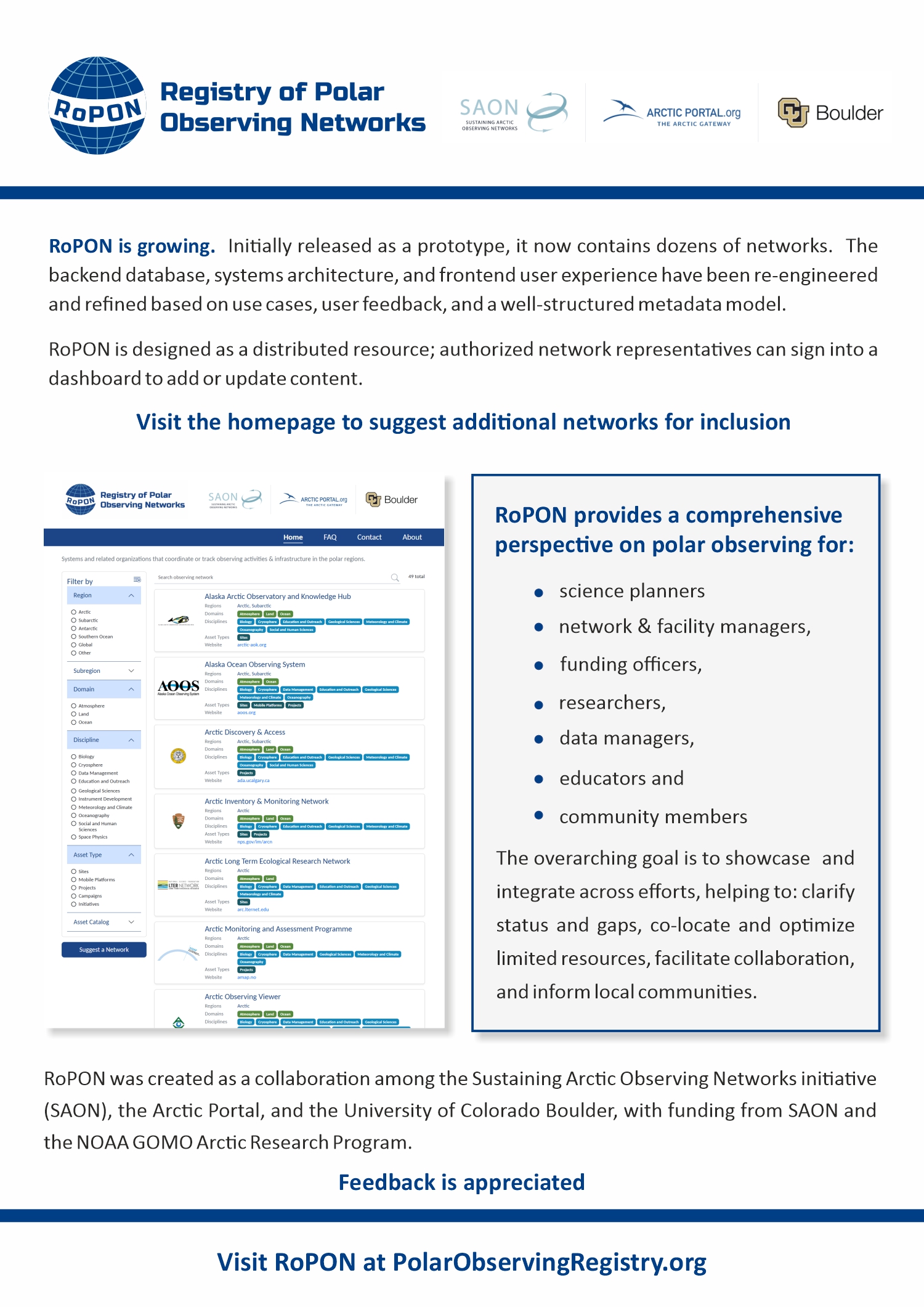
Key Features of RoPON
RoPON enables users to:
- Explore network descriptions, observational scopes, spatial coverage, and relevant assets.
- Identify data repositories, metadata access, and links to official information.
- Filter networks by region, domain, discipline, or asset type.
- Understand gaps, overlaps, and opportunities across a fragmented polar observing landscape.
The platform supports:
- Science planners
- Network & facility managers
- Funding agencies
- Researchers
- Data managers
- Educators
- Local and Indigenous communities
The registry also highlights network observing assets, including fixed stations, moorings, community-based monitoring sites, and supersites, where applicable.
The tags below provide an opportunity to view previously posted related news within the selected category