
Highlights
Nordic Experts Warn of Vulnerabilities in the AMOC Observing System
An interesting recent report, “AMOC Observation as Critical Infrastructure”, prepared by the Reykjavík Institute, draws upon the analytical frameworks developed by the Royal Netherlands Institute for Sea Research (NIOZ).
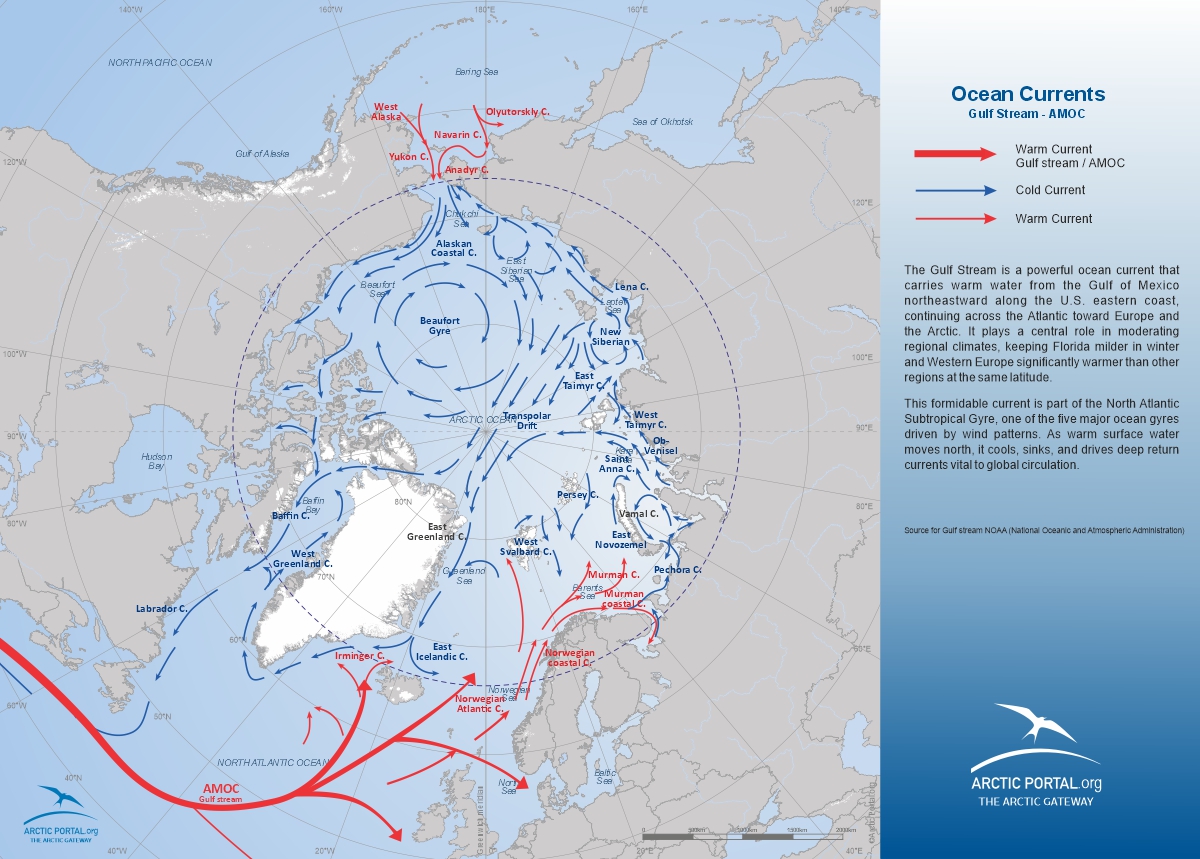
Integrating these approaches with specialized Nordic observational expertise, the report provides a comprehensive evaluation of the technical composition, financial foundations, and systemic vulnerabilities of the current Atlantic Meridional Overturning Circulation (AMOC) observing system. It further delineates the institutional and operational architecture required for the international coalition proposed in the Nordic Council of Ministers (NCM) report to ensure the long-term resilience and continuity of AMOC observations.
Critical infrastructure at the brink of collapse
The central thesis posits that the monitoring of the AMOC, a fundamental pillar of global climate stability vital to Northern Europe, should no longer be seen only as scientific research project, but should be politically recognized as a critical infrastructure for national security, especially for the Nordic countries. The current system is described as “at the brink of collapse” due to its reliance on short-term competitive grants rather than stable, long-term operational funding. Major observing programmes such as RAPID and OSNAP are particularly vulnerable, given their dependence on temporary funding cycles, multi-country coordination, and increasing political uncertainty surrounding climate-related financial commitments.
Through a detailed analysis of the contributions of the Nordic countries and Arctic gateways, the report outlines also, a series of urgent recommendations for ministers, including:
- diplomatic engagement with international partners
- the creation of emergency funding mechanisms for the 2026–2028 period
- the integration of AMOC monitoring into the upcoming EU Ocean Act
Sea-Level Rise and Food Security Risk!
Ultimately, the legitimacy of framing this effort as a security matter is validated by tangible socio-economic risks, such as a projected sea-level rise of approximately 50 cm along European coastlines and threats to these factors have already prompted nations such as Iceland and Finland to formally incorporate AMOC collapse within their national security and economic planning frameworks.
Chapter Overview
The full report is structured into four primary chapters that guide the transition from technical vulnerability to strategic resilience:
- Chapter 1: AMOC Observations are Critical Infrastructure.
This section argues for a fundamental shift in mentality, moving from a research-based "network of the willing" to a government-supported operational infrastructure. It aligns this shift with international frameworks, such as those from the IOC-UNESCO and the European Ocean Pact, which recognize ocean observation as a backbone for climate action and risk management.
- Chapter 2: Observations and Science
This chapter details the technical composition of the AMOC observing system, including basin-wide arrays like RAPID and OSNAP, and the integral role of broader systems like Argo and satellite altimetry. It emphasizes that Nordic gateway monitoring (covering the Greenland-Scotland Ridge, the Norwegian Sea, and Arctic gateways) is dynamically significant, as overflow production in these regions is a primary control on overturning strength. The chapter also highlights how sustained records enable the detection of AMOC decline and the reduction of uncertainty in climate projections.
- Chapter 3: Funding Status and Fragility
This section provides an in-depth analysis of the current financial landscape, categorizing observing components by risk level (Critical, At Risk, Vulnerable) and dependency type. It identifies three patterns of vulnerability: the mismatch of using short-term grants for decadal monitoring, the compression of institutional budgets not ring-fenced for observation, and the acute political instability affecting US federal funding.
- Chapter 4: Recommendations for Nordic Ministers
The final chapter presents six actionable recommendations. These include direct diplomatic engagement with the US, UK, and Netherlands; the establishment of a standing NCM coordination group; the preparation of backstop funding for the 2026–2028 transition; and the pursuit of national critical-infrastructure designation for Nordic observing assets.
Source: Reykjavík Institute
Related News:
Study Highlights Global Risks Linked to Shifts in Ocean ‘Conveyor Belt’