
Highlights
Registry of Polar Observing Networks (RoPON)
The Registry of Polar Observing Networks (RoPON) is a powerful resource designed to make high-latitude scientific observation and monitoring more findable, accessible, and connected.

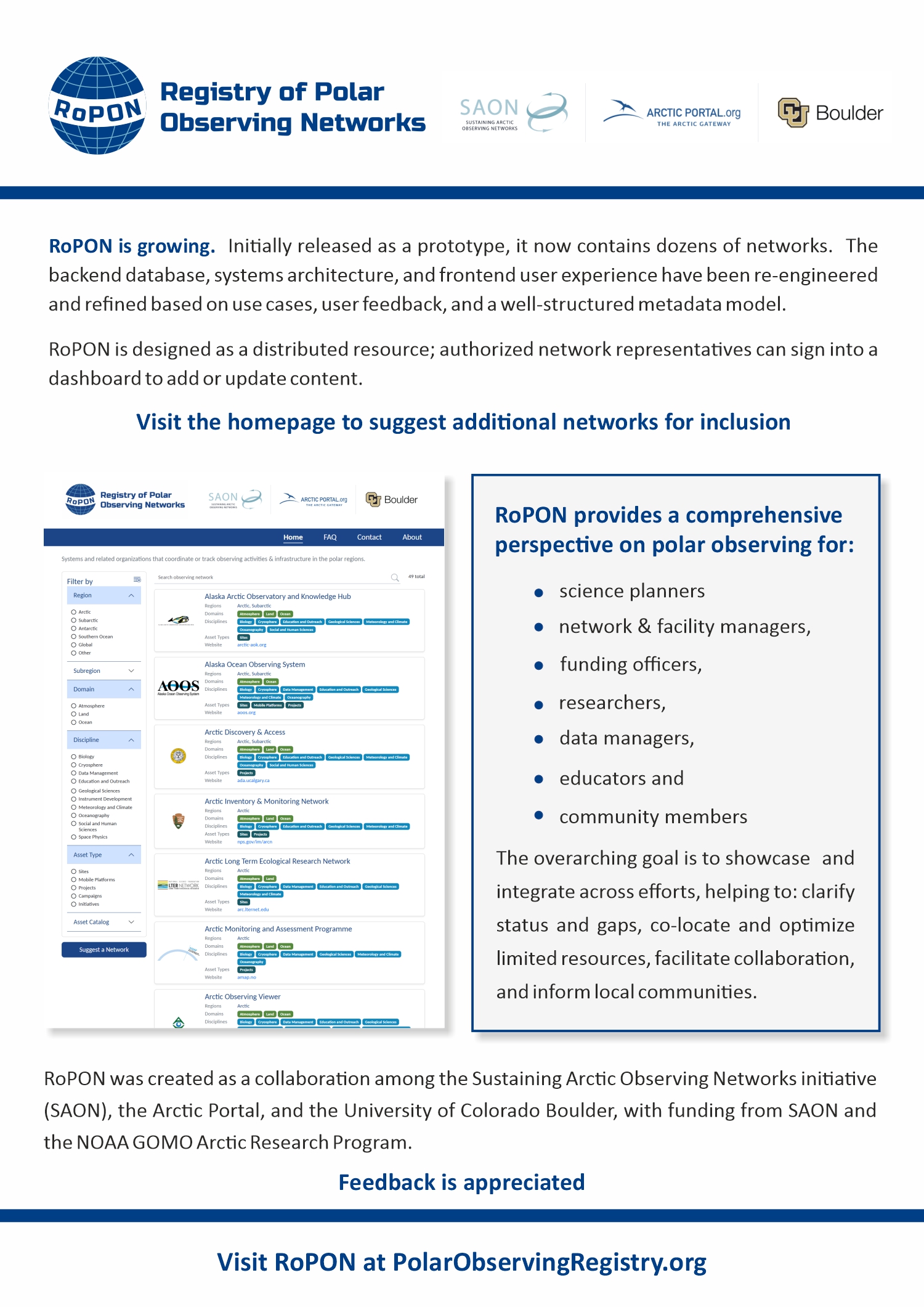 RoPON is a comprehensive catalog of observing systems and related organizations that coordinate, support, or track monitoring activities and infrastructure across the Arctic, Antarctic, and Southern Oceans. It brings together information that has traditionally been dispersed across multiple platforms, helping to create a clearer and more integrated picture of polar observing efforts.
The registry includes a wide range of networks involved in observing, research, infrastructure, and data management, such as SIOS, GTN-P, and NASA ABoVE, which play key roles in coordinating and supporting observations in polar regions.
Each observing network in RoPON is presented with detailed information, including a description, contact details, and links, as well as its observational scope, geographic extent, associated organizations, and related data repositories. The registry also indicates whether networks maintain inventories of observing assets, such as research stations, mobile platforms, satellites, campaigns, and initiatives, and whether these inventories are publicly accessible.
In addition to observing networks, RoPON also displays discovery portals and inventories that are not observing networks per se, but which compile and share structured information about observing activities and infrastructure, such as ARMAP, AOV, ISAAFFIK, and Polardex, further enhancing access to polar data and resources.
Designed as a distributed and evolving platform, RoPON allows authorized representatives of observing networks to log in and update or expand their information through a dedicated dashboard. The platform continues to grow and evolve, incorporating user feedback, real-world use cases, and a robust metadata framework.
RoPON provides a valuable tool for a wide range of users:
- Science planners can assess coverage, overlaps, and gaps in observing systems
- Network and facility managers can coordinate activities and optimize limited resources
- Funding agencies can better align investments and avoid duplication
- Researchers can identify collaboration opportunities and access facilities or datasets
- Data managers can locate and integrate data across multiple networks
- Educators can explore real-world observing systems and datasets
- Communities can discover and engage with observing activities in their regions
The overarching goal of RoPON is to showcase and integrate polar observing efforts, improve coordination, support collaboration, and help inform decision-making at local, regional, and global scales.
RoPON was developed through a collaboration between the Sustaining Arctic Observing Networks (SAON) initiative, the Arctic Portal, and the University of Colorado Boulder, with funding from SAON and the NOAA Global Ocean Monitoring and Observing (GOMO) Arctic Research Program.
Visit the webpage - polarobservingregistry.org
Arctic Portal’s Role in RoPON
Arctic Portal served as the technical engine behind the development of RoPON, delivering the system architecture, platform development, user interface, branding, and website that support the RoPON. The platform was built using modern, container‑based infrastructure to ensure reliability, scalability, and long‑term maintainability for the scientific community.
The successful launch of RoPON reflects Arctic Portal’s ability to design and implement advanced digital solutions for international scientific research initiatives. Our team continues to support science networks and organizations worldwide, and we remain ready to collaborate on new projects that require robust technical expertise and trusted digital stewardship.