
News
Arctic Council Project Preserves Indigenous Arctic Heritage
The Arctic Council’s Sustainable Development Working Group (SDWG) continues to advance international cooperation focused on the preservation of Indigenous languages and cultural heritage across the Arctic.
During the SDWG meeting held in March 2026, representatives of Arctic Indigenous Peoples’ organisations, researchers and experts gathered to discuss ongoing initiatives aimed at supporting Indigenous communities and safeguarding traditional knowledge.
Opening the meeting, Chair of the Senior Arctic Officials Kenneth Høeg of the Danish Ministry of Foreign Affairs emphasized Denmark’s commitment to supporting the continued work of the Arctic Council and facilitating cooperation among all Council members through meetings, seminars and expert exchanges.
Digital Preservation of Indigenous Heritage
One of the projects highlighted during the meeting was Digitalization of the Linguistic and Cultural Heritage of Indigenous Peoples of the Arctic, launched in 2021 under the Arctic Council framework.
The project is led by the Russian Federation, the Kingdom of Norway and the Russian Association of Indigenous Peoples of the North (RAIPON), in cooperation with the M.K. Ammosov North-Eastern Federal University (NEFU) and the Arctic University of Norway (UiT).
Professor Trond Trosterud of the Arctic University of Norway presented an update on the work carried out over the past five years to preserve and digitally document the languages, traditions and cultural knowledge of Arctic Indigenous Peoples.
Main Objectives of the Project
The project’s primary focus is the preservation and digital documentation of Indigenous cultural and linguistic heritage across the Arctic.
Key activities include:
- conducting expeditions and community-based workshops;
- interviewing and recording Indigenous language speakers and cultural knowledge holders;
- collecting linguistic, historical and cultural materials from public and private archives;
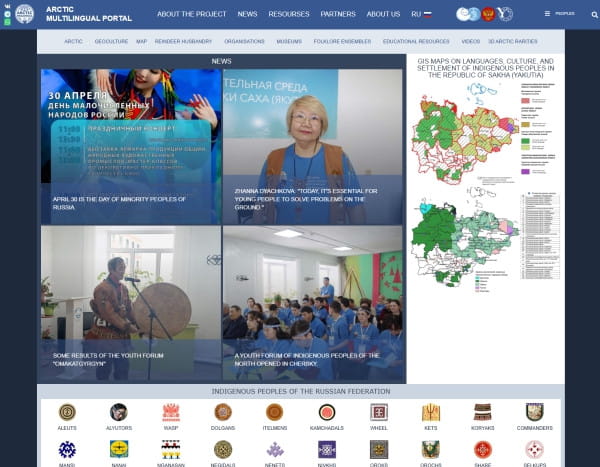
- developing the Arctic Multilingual Portal;
- creating GIS maps of Indigenous Peoples of the Arctic;
- and engaging Indigenous youth in cultural preservation work.
A major outcome of the initiative is the Arctic Multilingual Portal, an online platform dedicated to Indigenous languages, culture and traditional food heritage. The portal currently contains text, audio and video materials representing more than 40 Indigenous Peoples of the North, Siberia and the Far East.
Project participants emphasized that digital preservation efforts are essential for ensuring that future generations can maintain strong connections to their languages, traditions and cultural identity.
Norway Leads Language Technology Development
Alongside the broader cultural heritage activities, Norway is leading a separate language technology component within the project.
Researchers at the Arctic University of Norway are developing digital tools designed to support the use of Indigenous languages in modern digital environments. These include keyboard layouts compatible with smartphones, tablets and computers, as well as grammatical language models and proofing tools for circumpolar Indigenous languages including Mansi and Kildin Saami.
The work aims to make Indigenous languages more accessible in education, communication and digital media, while strengthening opportunities for their long-term use and revitalization.
According to project partners, these technologies may also lay the foundation for future machine translation tools for minority Arctic languages.
The future of the project
The project has been extended through 2026 and continues to expand its activities across the circumpolar Arctic.
Future plans include adding more Indigenous languages and cultural materials to the Arctic Multilingual Portal, extending language technologies to additional Arctic languages and strengthening cooperation with Indigenous communities in Canada, Greenland and the United States.
The initiative also contributes to the objectives of the United Nations International Decade of Indigenous Languages (2022–2032), which promotes the preservation, revitalization and global recognition of Indigenous languages.
View the Arctic Multilingual Portal
Related news:
The tags below provide an opportunity to view previously posted related news within the selected category