The battle against Climate Change
Numerous bodies have studied Climate change, with the eyes of seeing what it is, what it is doing and its effects. Some of them have come up with conclusions on what can be done to slow it down, so the people are given time to adjust.
The United Nations Framework Convention on Climate Change is one of the leading bodies. It was established in 1992 and is an international fight against Climate Change. From the convention the Kyoto Protocol was established. A total of 184 countries have signed and ratified it.
Finally organizations like the Intergovernmental Panel on Climate Change are doing extensive scientific research on climate change.
The Paris Agreement

The Paris Agreement is a legally binding international treaty on climate change. It was adopted by 196 Parties at the UN Climate Change Conference (COP21) in Paris, France, on 12 December 2015. It entered into force on 4 November 2016.
Its overarching goal is to hold “the increase in the global average temperature to well below 2°C above pre-industrial levels” and pursue efforts “to limit the temperature increase to 1.5°C above pre-industrial levels.” However, in recent years, world leaders have stressed the need to limit global warming to 1.5°C by the end of this century. That is because the UN’s Intergovernmental Panel on Climate Change indicates that crossing the 1.5°C threshold risks unleashing far more severe climate change impacts, including more frequent and severe droughts, heatwaves, and rainfall. To limit global warming to 1.5°C, greenhouse gas emissions must peak before 2025 at the latest and decline 43% by 2030. The Paris Agreement is a landmark in the multilateral climate change process because, for the first time, a binding agreement brings all nations together to combat climate change and adapt to its effects.
How does the Paris Agreement work?
Implementation of the Paris Agreement requires economic and social transformation, based on the best available science. The Paris Agreement works on a five-year cycle of increasingly ambitious climate action -- or, ratcheting up -- carried out by countries. Since 2020, countries have been submitting their national climate action plans, known as nationally determined contributions (NDCs). Each successive NDC is meant to reflect an increasingly higher degree of ambition compared to the previous version.
Recognizing that accelerated action is required to limit global warming to 1.5°C, the COP27 cover decision requests Parties to revisit and strengthen the 2030 targets in their NDCs to align with the Paris Agreement temperature goal by the end of 2023, taking into account different national circumstances.
How do they track progress?
With the Paris Agreement, countries established an enhanced transparency framework (ETF). Under ETF, starting in 2024, countries will report transparently on actions taken and progress in climate change mitigation, adaptation measures and support provided or received. It also provides for international procedures for the review of the submitted reports.
The information gathered through the ETF will feed into the Global stocktake which will assess the collective progress towards the long-term climate goals.
This will lead to recommendations for countries to set more ambitious plans in the next round.
What has been achieved so far?
Although climate change action needs to be massively increased to achieve the goals of the Paris Agreement, the years since its entry into force have already sparked low-carbon solutions and new markets. More and more countries, regions, cities and companies are establishing carbon neutrality targets. Zero-carbon solutions are becoming competitive across economic sectors representing 25% of emissions. This trend is most noticeable in the power and transport sectors and has created many new business opportunities for early movers.
By 2030, zero-carbon solutions could be competitive in sectors representing over 70% of global emissions.
Read more about the Paris Agreement
United Nations / Climate Change Website
Source: UN
Kyoto Protocol
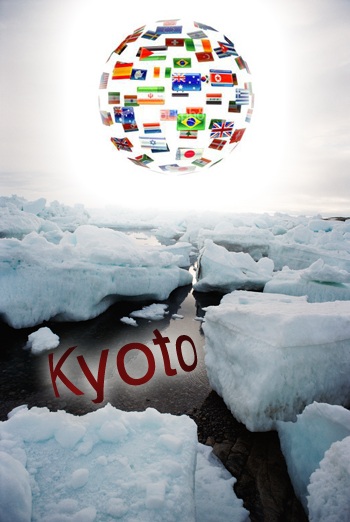
The Kyoto Protocol is a protocol to the United Nations Framework Convention on Climate Change (UNFCCC) in the battle against climate change. It is a treaty that has been signed and ratified by 184 countries with the goal of achieving the "stabilization of greenhouse gas concentrations in the atmosphere at a level that would prevent dangerous anthropogenic interference with the climate system." It entered in force in 2005.
The major feature of the Kyoto Protocol where the targets for 37 industrialized countries and the European Community for reducing greenhouse gas emissions .The target is an average of five per cent against 1990 levels between 2008-2012. In addition to the limits, the Kyoto Protocol introduces three mechanisms how the targets are to be met.
Primarily, the countries must reduce their emissions through national measures, meaning that they have to take action to actually diminish their greenhouse gas pollution. But since the economies of most countries are highly dependent on industries that are high polluters, three other mechanisms were introduced to ease the reduction scheme.
The first mechanism introduced in the Kyoto Protocol is the Emissions Trading. Emissions trading, as set out in Article 17 of the Kyoto Protocol, allows countries that have emission units to spare - emissions permitted them but not "used" - to sell this excess capacity to countries that are over their targets. This scheme is in use for example in the European Union and is one of the largest trading schemes in operation.
Second mechanism provided by the Kyoto Protocol is the Clean Development Mechanism (CDM), defined in Article 12 of the Protocol. The CDM is a purchase system where saleable certified emission reduction (CER) credits can be earned by implementing an emission-reduction project in developing countries. This is a unique global environmental investment system and there exists now 1849 registered CDM project activities.
Third mechanism is so called „joint implementation" ,defined in Article 6 of the Kyoto Protocol. The „joint implementation" allows an Annex II country to earn emission reduction units (ERUs) from an emission-reduction or emission removal project in another Annex II country through a flexible and cost-efficient foreign investment and technology transfer.
Source:The Kyoto Protocol
UN Framework convention
The International response to climate change was initiated at the Earth Summit in Rio De Janeiro in 1992 with the signing of the U.N Framework Convention on Climate Change (UNFCCC).
It is an international treaty on environmental law aiming at reducing the greenhouse gas concentrations in the atmosphere.
The UNFCCC does not lay down any binding limits of reduction, but divides the signatories to the convention in to three categories each category agreeing to reduce their emissions of greenhouse gas a certain amount.
First category of industrialized countries, so called Annex I countries, agree to reduce their emissions of greenhouse gasses to targets that are mainly set below their 1990 levels. These countries are Australia, Austria, Belarus, Belgium, Bulgaria, Canada, Croatia, Czech Republic, Denmark, Estonia, Finland, France, Germany, Greece, Hungary, Iceland, Ireland, Italy, Japan, Latvia, Liechtenstein, Lithuania, Luxembourg, Monaco, Netherlands, New Zealand, Norway, Poland, Portugal, Romania, Russia, Slovakia, Slovenia, Spain, Sweden, Switzerland, Turkey, Ukraine, UK and USA.
Annex II countries, developed countries that are to pay for the costs of developing countries for their efforts to reduce greenhouse gasses, are Australia, Austria, Canada, Denmark, Finland, France, Germany, Greece, Iceland, Ireland, Italy, Japan, Luxembourg, Netherlands, New Zealand, Norway, Portugal, Spain, Sweden, Switzerland, UK, USA and the European Union.
Finally, in the Annex III are developing countries and countries with economy in a transition.
Today, the UNFCCC enjoys near-universal membership having 192 signatory members. The members meet annually in Conferences of the Parties (COP), in which they assess progress and negotiate binding rules on greenhouse gas emissions.
One of the most significant COPs has been the COP-3 in 1997 in Kyoto, Japan, where the so called Kyoto Protocol, the legally binding protocol on emission reduction, was adopted.
Source:The UN Framework Convention on Climate Change
The Intergovernmental Panel on Climate Change
The Intergovernmental Panel on Climate Change (IPCC) is the leading international body for the assessment of climate change. It was established by the United Nations Environment Program (UNEP) and the World Meteorological Organization (WMO) to provide the world with a clear scientific view on the current state of knowledge in climate change and its potential environmental and socio-economic impacts.
The UN General Assembly endorsed the action by WMO and UNEP in jointly establishing the IPCC.
The IPCC is a scientific body. It reviews and assesses the most recent scientific, technical and socio-economic information produced worldwide relevant to the understanding of climate change. It does not conduct any research nor does it monitor climate related data or parameters.
Thousands of scientists from all over the world contribute to the work of the IPCC on a voluntary basis. Review is an essential part of the IPCC process, to ensure an objective and complete assessment of current information.
IPCC aims to reflect a range of views and expertise. The Secretariat coordinates all the IPCC work and liaises with Governments. It is supported by WMO and UNEP and hosted at WMO headquarters in Geneva.
The IPCC is an intergovernmental body. It is open to all member countries of the United Nations (UN) and WMO. Currently 194 countries are members of the IPCC.
Governments participate in the review process and the plenary Sessions, where main decisions about the IPCC work program are taken and reports are accepted, adopted and approved. The IPCC Bureau Members, including the Chair, are also elected during the plenary Sessions.
Because of its scientific and intergovernmental nature, the IPCC embodies a unique opportunity to provide rigorous and balanced scientific information to decision makers. By endorsing the IPCC reports, governments acknowledge the authority of their scientific content. The work of the organization is therefore policy-relevant and yet policy-neutral, never policy-prescriptive.
Source:IPCC