
Culture
The Arctic is not an empty wilderness. It is a homeland. It is a region where ancient cultures and modern governance coexist, where Indigenous languages persist alongside global languages, and where traditional subsistence practices intersect with industrial development.
40 Mln km2
Approximate are of the arctic
40 Mln
People living across the region
40+
Indigenous languages
12000+ years
Evidence of human presence
Early Arctic Settlement
Archaeological evidence suggest that humans have lived in Arctic region for at least 12,000 years, based on findings in northern Russia. Some researchers propose even earlier habitation, though this remains debated.

Peoples, Languages, Places
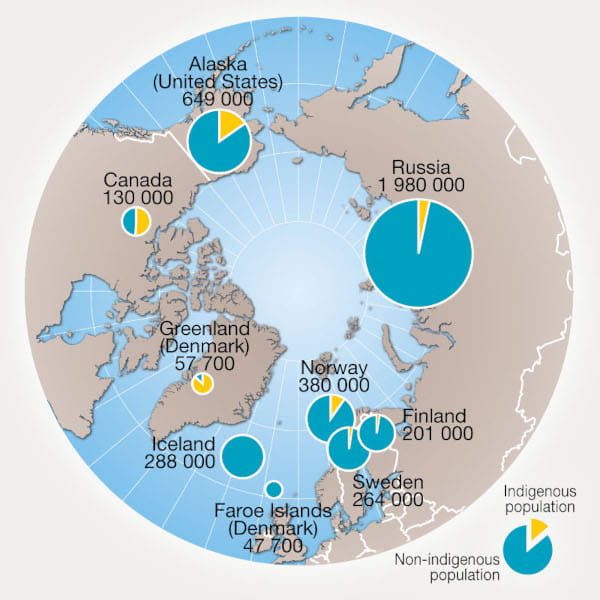
The Arctic covers approximately 40 million square kilometers, or about 8% of the Earth's surface, yet it is home to only around four million people.
Among these are numerous Indigenous peoples whose ancestors inhabited the region long before the arrival of Europeans. Today, most Arctic Indigenous communities live as minorities with modern nation-states.
Greenland is the exception, where Inuit make up approximately 88% of the population. In northern Canada, Indigenous peoples account for roughly half of the population in some regions. In Alaska, Indigenous peoples represent about 20% of the population, while in northern Scandinavia and Russia they make up approximately 4-5%.
Around 40 Indigenous languages are still spoken across the Arctic. However, Russian, English, and Scandinavian languages are dominant in public life and administration.
Greenland is uique in that Kalaallisut (Greenlandic), an Inuit language, is the official language. In Canada's territory of Nunavut, Inuktitut, English, and French are recognized as official languages.
Indigenous Peoples of the Russian Arctic
Explore more