Effects of Climate Change
Climate change will have many effects and some of them can already be seen around the world. Climate change is important in the Arctic as the changes and effects are clearly visible.
It is estimated that Climate Change will reduce Arctic sea ice significantly, increase shipping activities in the area, change fisheries and ecosystems and increase in oil and gas extraction in the Arctic.
On September 10th 2011, the Arctic sea ice extent was 4.34 million square kilometers (1.68 million square miles). This was 110,000 square kilometers (42,500 square miles) above the 2007 value on the same date, the record minimum Arctic sea ice extent. The extent then was 4.17 million square kilometers (1.61 million square miles).
Although most scientists agree on that the globe is becoming warmer, predictions on how rapidly Arctic ice will retreat often vary greatly amongst them. The schedule is however not as important as the results of this development and the possibility of the ice-free Arctic to become a lucrative shipping route.
For oil and gas, climate change will challenge the petroleum sector in many ways. Offshore oil exploration and production is likely to benefit from less extensive and thinner sea ice, although equipment will likely be costlier as it will be required to withstand increased wave forces and ice movement. In addition, accident and collision insurance, authority for regulation, enforcement and cleanup in management of natural resources and environmental protection will become important issues because final delimitation of Arctic waters is still not firmly settled among Arctic nations. Increased ship access will most likely also raise many destabilizing international issues, which need to be dealt within an appropriate political and legal infrastructure.
The opening of Arctic shipping routes will certainly lead to more energy efficient transport of goods. The shipping of goods from Asia to Europe is in fact relatively shorter trough the Arctic than through the Suez-Canal or the Panama-Canal, which in turn means less emissions of CO2.
Arctic marine transportation can therefore be both affected by climate change and influence accelerated global warming. Greenhouse gas emission restrictions will be one of the determinant factors in encouraging Trans-Arctic shipping, along with pressure from industry stakeholders. Changes in Arctic ecosystems with increased environmental awareness can though hold back activities that otherwise would become possible or even feasible due to the reducing sea ice and warmer climate.
Although no legally binding agreement on emission reductions has yet been reached, it must be kept in mind that post-Kyoto protocol is still under consideration in the global climate politics. If an industrial state would only need to restrict emissions for 5-10%, burdensome CO2 emissions would first be tackled in areas where new technology exists and is relatively cheap leaving room for Arctic operations.
Source:Arctic Marine Shipping Assessment 2009
Indigenous Peoples
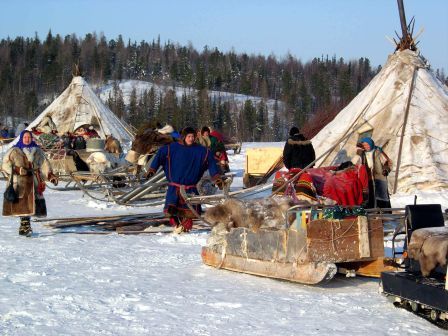
Indigenous peoples in the Arctic are one of the most vulnerable to the climate change effects and extremely susceptible to its direct adverse consequences which partly own their significant relationship with the natural environment and its resources. The knowledge about climate change effects on aboriginal livelihoods comes mostly from the experience and carful observations while interacting with the natural environments.
Compering the experience of indigenous people from all over the northern hemisphere, large number of common issues emerge. The Intergovernmental Panel on Climate Change reflected that the climate change has been greatly affecting the remote Arctic livelihoods.
However, the United Nations Framework Convention on Climate Change neither the Kyoto Protocol does not explicitly discuss the matter of indigenous and traditional people with regards to the global problem of climate change. Nevertheless, since early 21st century, the indigenous representatives via their organizations have been involved in climate change negotiation and released great number of statements, reports and declarations in which they have been expressing their concerns about the climate change current policy.
Recently, the most visible features of changing climate in the Arctic are the vacillating weather conditions. The statistics inform that the atmospheric conditions seem to be very unstable and almost impossible to be predicted by traditional approach which used to be the only reliable method for indigenous communities. The winter season brings more rain and less snow to northern regions and the summer pattern extends what makes the water level drop in lakes and the sea ice to decline.
It was reported that animal species which have not been seen in the Arctic before, inhabit its ecosystems. In the northern parts of Canada, indigenous groups noticed the reduction of some seal species in the areas where the sea ice gets thinner. Instead, the unknown species of birds and insects occurred. Having a great impact on indigenous culture, climate change causes a problem of survival not only for seals, which are the single most important food source for Inuit, but also for polar bears which are not likely to stay alive in warmer summer conditions.
According to the meteorological research, increased amount of summer storms has been growing annually causing the natural erosion of coastal areas. What is more, the Saami from northern, European Arctic has observed that advancing wind speed confuse the navigational instincts of reindeers what forces changes in traditional travel paths.
Besides having a great impact on indigenous peoples 'culture, food security and traditional lifestyle, climate change greatly effects human health. Because of longer and warmer summers, sun seems to feel stronger and sharper what causes unknown among remote northern communities, skin rashes and even cancer.
The governments of the Arctic states came together with the joint forces to create the framework for climate change mitigation. Indigenous communities of Polar Regions as well as North America have been greatly included in the reports. Taking into the account that the cost of climate change is mainly handled by the rather poor, natural resource dependent communities, the importance of monetary, technology and knowledge transfer from developed countries is being adopted.
Source:Intergovernmental Panel on Climate Change - IPCC
Sea Ice
Global warming poses, probably the biggest threat to Arctic natural environment. It occurs as the effect of climate change on all Arctic physical systems such as sea ice and ice cap, atmosphere and oceans, permafrost and snow. What is more, the global warming effect has a great impact on diverse biological systems such as endangered Arctic species and remote, ecosystems.
Even though the climate change occurs on all Arctic system levels as listed above, it notably touches the Arctic sea ice and the Greenland ice sheet. The scientific research shows, that the changes caused by the global warming are happening much faster than expected.
In terms of magnitude of the ongoing changes within the northern hemisphere, the melting Greenlandic Ice Cap could largely contribute to the global rise of the level of the oceans. Currently, Greenland is covered by the ice sheet which volume reaches close to 2.9 million km3, what is, excluding Antarctic ice sheet, the world´s record.
It was measured that if the Greenlandic sea ice was to melt, the world´s average sea level would rise by about 7.3 m. Arctic Climate Impact Assessment does not predict the timeframe for the issue to be completed.
Warming temperature and longer summer period in the Arctic decreased the sea ice to reach 39% less than twenty years ago. It was measured that in the past couple of years the sea ice extent went down to 4.3 million km2.
Melting ice cap is the first and the most visible effect of the climate change. Following effects as on the ocean circulation, atmosphere and Arctic natural environment can be easily predicted and rapidly grow to be a global concern. The Arctic states have taken necessary steps to mitigate the impacts of the climate change on Arctic ice sheet, however the ongoing challenge doubtlessly requires the world wide response.
Source:Arctic Climate Impact Assessment
Security
International Panel on Climate Change addressed the higher temperatures to be affecting all aspects of northern circle. Climate change has been having a great impact on sea ice extent in the Arctic, opening new shipping routes and in the same time the gross of opportunities for trans – arctic commercial enterprises.
However, melting ice and rising level of the oceans also started to become a threat to indigenous human population in the northern hemisphere, disturbing their aboriginal ways of life, dependent on atmospheric circulations.
The statistics provided by IPCC state, that in the most Arctic states, excluding highly industrialized parts, water use has significantly increased over the past twenty years. Constantly growing Arctic human population, living different, more modern lifestyle and with developing economy would be likely to extend the use of water supply.
Being well know, water is the essential to the life on the planet and the prosperity of its people. Increasing evidences of climate change, constant population growth combined with urbanization and evolving needs for energy sources, are putting a great pressure on the global water resources. The effects of climate change are particularly and significantly felt when considering the future of water security.
The effects on climate change can be clearly visible in all parts of the Arctic. They occur as reduced snow cover, widespread melting of ice, and changes in soil moisture and runoff and precipitation patterns. What is more, water supplies stored in the glaciers and snow cover in the high Arctic are predicted to be shrinking in the coming years what means that the water availability for the remote indigenous communities during the dry and warm summer periods, would be reduced.
Scientists predict that the water quality would deteriorate as higher temperatures allow many forms of water pollution. The rise of sea level would dissolve organic carbon causing the decrease of fresh, ground water availability for populations and ecosystems of Arctic coastal territories.
Together with water security, the issue of climate change greatly affects all aspects of food security in the Arctic. Food availability and accessibility, food utilization and food systems stability are the four categories recognized by Food and Agriculture Organization of the United Nations to be threatened by the changing climate.
Indigenous Arctic communities, strongly dependent on traditional ways of gathering food supplies are at the first place affected by the global warming. Raising temperatures do not allow for all activities linked to hunting and harvesting of Arctic animals. Fishing is likely to be affected by the climate change as the warmer water ecosystem allow the development of living resources which have been never seen before in the northern hemisphere.
Climate change has its impact on animal growth and its migration, land use and production. Even though, the Arctic land is of very little use for agricultural activities, the food production strongly depends on atmospheric changes. Being able to estimate the location of Arctic animals used to be of a great use for indigenous hunters.
It was proven that because of the melting ice, longer summer periods and shorter time of vegetation, animals start to migrate or their location is difficult to verify.
Various Arctic plants are used by the indigenous peoples not only as food but also as medicine, what makes a warming planet a serious threat to cultural, traditional values of northern populations. On the other hand, with melting ice and opening of new shipping routes, food distribution among remote Arctic communities, become easier and more sufficient.
Climate change has been occurring as the major threat to indigenous people health. Unknown diseases seem to touch remote northern populations. The cost of global warming brings the new insects and bacteria. Longer summer periods and sharper sun cause gross of skin diseases, even a cancer.
There are still major fields of uncertainty with regards to climate change and water studies. Understanding and attribution of all the climatic changes and their impact on the water and food security, occurs as a global challenge. Intergovernmental Panel on Climate Change involves the governments of all Arctic states to participate in decision making process with regards to climate change mitigation challenges. There is an ongoing need for all Arctic social and political powers to contribute to the problem as well as to develop mechanism for its better understanding.
Source:Climate Change and Water - IPCC Technical Paper VIIntergovernmental Panel on Climate Change - IPCC