
News
European Arctic Summit Outlines New Priorities for the Arctic
European leaders meeting in Rovaniemi highlighted the Arctic’s growing importance for European security, resilience and sustainable development, calling for a stronger and more coordinated EU role in the region.
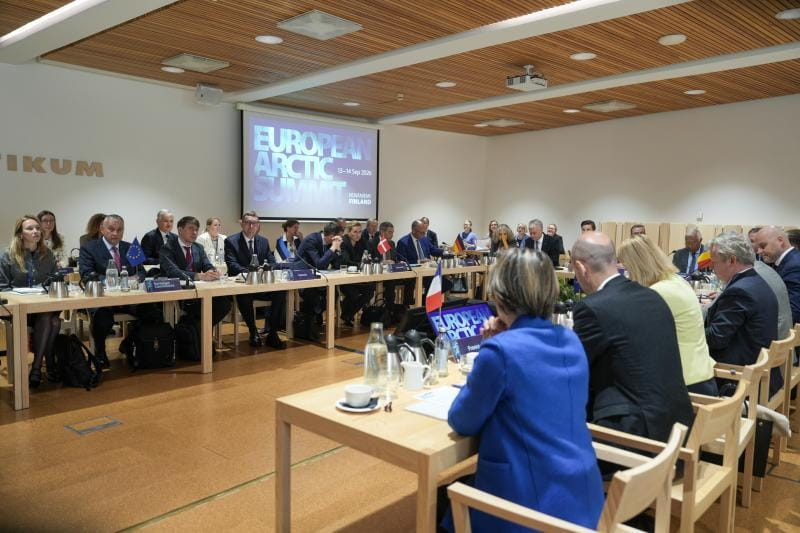
General view of the European Arctic Summit, Rovaniemi, Finland, 13 September 2026. Photo: Alessandro Rampazzo / European Commission Audiovisual Service. © European Union, 2026, licensed under CC BY 4.0.
The European Arctic Summit, held in Rovaniemi, Finland, on 13–14 September 2026, brought together leaders from more than ten European Union Member States to discuss the changing strategic environment in the Arctic and the future role of the EU in the region. Hosted by Finnish Prime Minister Petteri Orpo, the meeting focused on security, infrastructure, economic development, climate change and cooperation.
A joint statement issued by Finland, Denmark, Estonia, France, Greece, Germany, Latvia, Lithuania, the Netherlands, Poland, Romania and Sweden described the Arctic as a region undergoing rapid transformation. The participating countries pointed to intensified great-power competition, the consequences of Russia’s war against Ukraine, China’s growing security-policy interest in the region and the accelerating effects of climate change as factors reshaping the Arctic strategic environment.
Arctic security as a European issue
One of the central messages emerging from the Summit was that developments in the Arctic are increasingly connected to wider European security.
The joint statement stressed that the European Arctic is an integral part of the European Union and includes both land and maritime areas, as well as a long external EU border with Russia. At the same time, the participating countries reaffirmed their commitment to maintaining the Arctic as a region of peace, stability and constructive cooperation based on international law, territorial integrity, multilateral governance and the Law of the Sea.
Security concerns nevertheless occupied an important place in the discussions. The joint statement described Russia as posing a significant long-term challenge to Euro-Atlantic security and referred to its ambitions in the Arctic and increased hybrid activities as reasons for strengthening the EU’s Arctic policy.
Speaking after the Summit, European Council President António Costa similarly emphasised that Arctic security should be understood as part of European security. He noted that Denmark, Finland and Sweden are Arctic EU Member States and argued that the changing geopolitical environment requires the European Union to adapt its approach while maintaining the existing priorities of climate protection, sustainable development and peaceful cooperation.
A stronger and more prepared EU presence
The participating countries called on the European Union to take a more strategic and proactive role in the European Arctic.
Among the priorities identified were stronger monitoring and analytical capacities, improved maritime domain awareness, greater use of Member States’ space-based capabilities and better information sharing. The statement also highlighted investment in military mobility, cross-border connections, digital and transport infrastructure, satellite technologies and the protection of critical infrastructure on land and at sea.
Prime Minister Orpo presented Arctic security as a broader issue extending beyond the military dimension. According to the Finnish government, discussions also covered economic security, critical minerals, energy, infrastructure and logistics, trade routes, security of supply, climate change and sustainable development.
The joint declaration also called for close coordination between the EU, its Member States and like-minded partners, including complementarity with NATO and cooperation with other international organisations.
Economic development and connectivity
Economic opportunities were another major theme of the Summit.
The leaders identified critical raw materials, space technologies, Arctic and intercontinental shipping, connectivity and tourism as areas with potential for sustainable economic development. They emphasised that these opportunities should also benefit people living in the region.
Critical infrastructure and connectivity were presented as closely connected to both regional development and European resilience. The statement called for investment in transport links and digital infrastructure in the EU’s northernmost regions, alongside the development of safe and secure capabilities for operating in Arctic conditions.
The leaders also welcomed the recently announced EUR 200 million EU–Greenland Partnership Package as part of the Union’s broader engagement in the region.
Climate, science and Arctic communities
Despite the increased focus on security, environmental protection and sustainable development remained central to the Summit’s conclusions.
The joint statement underlined the importance of protecting the Arctic’s fragile ecosystems, supporting the transition to clean energy and ensuring responsible management of natural resources. It also stressed the role of sustainable economic activity and engagement with Indigenous Peoples and local communities in supporting long-term stability and prosperity.
Scientific research and international academic cooperation were also recognised as important foundations for knowledge-based governance and for understanding the Arctic’s role in global climate change.
The participating countries reaffirmed their commitment to the rights, livelihoods and cultures of Arctic Indigenous Peoples and to their effective participation in decisions affecting the region, referring specifically to the principles set out in the United Nations Declaration on the Rights of Indigenous Peoples.
Towards an updated EU Arctic policy
The Rovaniemi meeting comes as the European Commission and the European External Action Service are working on an update of the EU’s Arctic policy.
President Costa said the revision is intended to respond to a changing geopolitical, economic and environmental context while preserving the EU’s existing focus on peaceful cooperation, sustainable development and climate protection. He also indicated that Arctic security and defence will feature in discussions on the EU’s next long-term budget.
The joint statement meanwhile looked ahead to the forthcoming Joint Communication by the European Commission and the High Representative on a Resilient, Secure and Peaceful Arctic, calling for stronger EU engagement, adequate resources and concrete action in response to the region’s changing circumstances.
The European Arctic Summit therefore placed the Arctic firmly within the broader European debate on security, resilience, connectivity, sustainable development and climate policy, while maintaining cooperation and international law as central principles for the region.
Sources:Topmødeerklæring fra European Arctic Summit, European Council.
Image credits: Cover image: Alessandro Rampazzo / European Union, 2026 – EC Audiovisual Service. Licensed under CC BY 4.0. Image adapted and used as part of the cover collage. Article image: Alessandro Rampazzo / European Union, 2026 – EC Audiovisual Service. Licensed under CC BY 4.0.
The tags below provide an opportunity to view previously posted related news within the selected category