
News
Northern Notes 65: Updates from the Arctic Social Sciences Community
The Spring/Summer 2026 issue of Northern Notes, the newsletter of the International Arctic Social Sciences Association (IASSA), brings together preparations for ICASS XII, association news, Indigenous mentorship, events and opportunities, conference reports, research features and new publications.
ICASS XII Coming Up
The International Congress of Arctic Social Sciences (ICASS XII) is planned for 31 May–4 June 2027 in Nuuk, Greenland, under the theme “Our Arctic – Our Future: Coming Together”. It will bring together researchers, students, policymakers and practitioners to discuss social affairs, geopolitical developments, economic development, environmental issues, Indigenous rights and other topics affecting the region.
The University of Greenland and the Stefansson Arctic Institute at the University of Akureyri are working together to organise the congress. Katuaq is the planned main venue, with parallel sessions at Hotel Hans Egede and space for workshops and meetings at the university. The organisers aim to accommodate around 500 participants and are seeking funding, including scholarships to help early-career students attend.
The preliminary timeline published in the newsletter lists a call for abstracts in September 2026, an abstract deadline in December, registration opening in March 2027 and a registration deadline in April. The final programme is planned for May 2027.
News from IASSA
The issue introduces Sveinbjörg Smáradóttir and Helga Guðrún Númadóttir as the new Secretariat members and announces the Secretariat’s move to the Stefansson Arctic Institute in Akureyri, Iceland. Their backgrounds include Arctic social sciences, anthropology and polar law.
Members will also find calls for nominations for the IASSA President, Council and awards. The submission deadline is 30 April 2027, with elections scheduled during the General Assembly in Nuuk on 4 June 2027. The awards recognise contributions to Arctic social sciences and humanities, service to IASSA, and the work of early-career Indigenous scholars.
Further information explains how to join or renew IASSA membership and subscribe to receive updates and Northern Notes by email.
Events and opportunities
The events calendar includes:
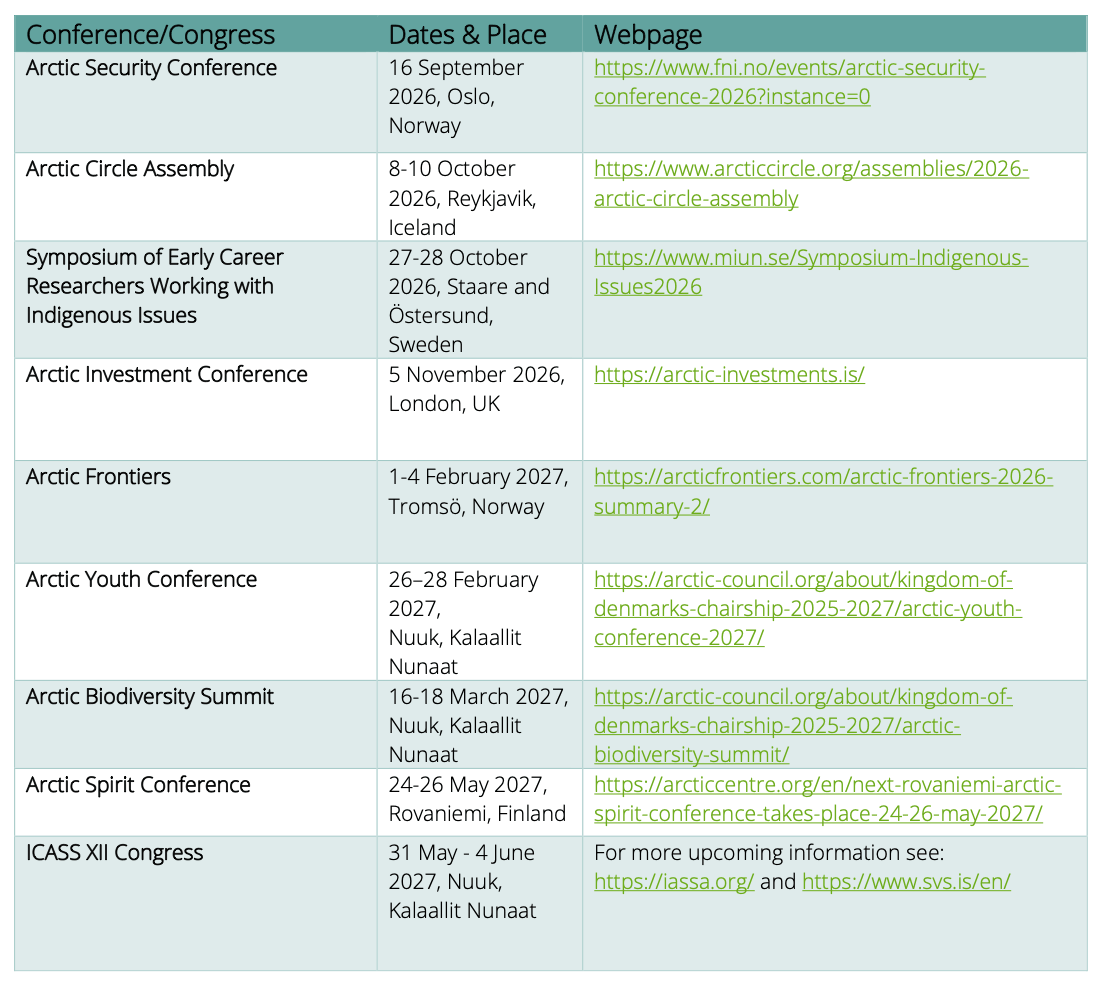
Supporting early-career Indigenous scholars
Anita Lafferty and Tatiana Degai introduce the Indigenous Aunties Mentorship Program, which supports early-career Arctic Indigenous scholars through mentoring grounded in Indigenous knowledge, values and community relationships.
The article explains how Aunties, Elders and knowledge holders guide younger generations and support learning through relationships, listening and shared experience. The programme aims to strengthen personal and professional development, help scholars navigate IASSA and other academic conferences, and create a welcoming space for Indigenous ways of knowing.
The issue also includes an invitation to join the Arctic Indigenous Aunties Mentorship Circle, with a QR code that allows interested early-career Indigenous scholars to express their interest in taking part in the programme ahead of ICASS XII.

Reports from the polar research community
A report by Maria Ackrén covers the Polar Symposium 2026, held in Monaco on 25–27 February 2026. Discussions focused on international cooperation, research funding and ways to put polar research into practice. The report also highlights exchanges related to the International Polar Year 2032–2033.
A second contribution, by Andrey Kazakov, reports on the UArctic Congress, held in Tórshavn, Faroe Islands, on 26–29 May 2026. It presents a session organised by the Young Arctic project in cooperation with the Social, Economic, and Cultural Expert Group. Participants discussed youth entrepreneurship, innovation and support for local initiatives that create opportunities for young people to build their futures in the North.
Research on Arctic coastal change
The Features section presents Nicholas Parlato’s doctoral research on coastal change and environmental governance in Arctic Alaska.
His thesis examines how human-driven coastal change affects not only infrastructure and human security, but also the ways societies understand and govern relationships between people and the environment. It questions conventional scientific and management approaches and highlights the importance of different ways of knowing, including Indigenous knowledge, as well as the role of nonhuman actors and environmental relationships.
Using the Alaska Coastal Management Program (1979–2011) as a case study, the research shows the importance of trust, communication and long-term collaboration between coastal communities and public institutions. It also explores how Indigenous and Western knowledge systems, animals, infrastructure, territories and seasons contributed to coastal management practices.
The thesis concludes by addressing the institutional gap along Alaska’s coasts, the challenges faced by Alaska Native Tribes in asserting sovereignty over coastal areas and resources, and the growing impacts of cryospheric degradation. It proposes approaches that strengthen Tribal sovereignty, rights of nature and procedural equity in environmental decision-making.
Arctic Council update: emergency preparedness
The Arctic Council section announces “Cold Seas – Critical Gaps”, an emergency preparedness event planned for 13–15 October 2026 in Tórshavn, Faroe Islands, as part of the Kingdom of Denmark’s Arctic Council Chairship programme. It will address prevention, preparedness and response to marine incidents involving cruise ships and passenger ships in the Arctic and North Atlantic.
According to the announcement, the event will be open to public participation. Online attendance will be free but will require registration, with streaming limited to plenary sessions rather than breakout discussions.
New publication: sacred places and cultural heritage
The issue presents Sacred Places in the Arctic and Beyond, edited by Francis Joy, Patrick Dillon and Dawid Bunikowski. The book brings together Indigenous and non-Indigenous scholars, rightsholders and practitioners to explore sacred places as cultural heritage and their connections to traditions, identity, memory and biodiversity.
Case studies from the Arctic and other regions examine access to sacred places, pressures from extractive industries and tourism, and challenges surrounding their management. The book also considers how laws and management approaches can better reflect Indigenous understandings of these places.
The tags below provide an opportunity to view previously posted related news within the selected category